
GuangChen Li (李光宸)
 University of Michigan, Ann Arbor
I am an M.S. student in Data Science at the University of Michigan, Ann Arbor, with expected graduation in May 2027. My research focuses on generative modeling, time series, and world models.
I received my B.S. in Physics from Renmin University of China in 2025 and was a visiting student at the University of California, Davis in 2024. Feel free to contact me if you are interested in related research or potential collaborations.
Education
-
University of Michigan, Ann Arbor
Department of StatisticsM.S. in Data Science Aug. 2025 - Present -

Renmin University of China
School of PhysicsB.S. in Physics Sep. 2021 - Jun. 2025 -
University of California, Davis
Visiting Student Mar. 2024 - Jul. 2024
Awards
- Merit Student 2024
- Second Prize, National College Student Mathematics Competition 2024
- Academic Progress Scholarship 2023
News
Publications (view all )
Raster or Random? Let the Data Decide
Lianghe Shi*, GuangChen Li*, Huijie Zhang, Yixuan Jia, Qing Qu (* equal contribution)
Under review
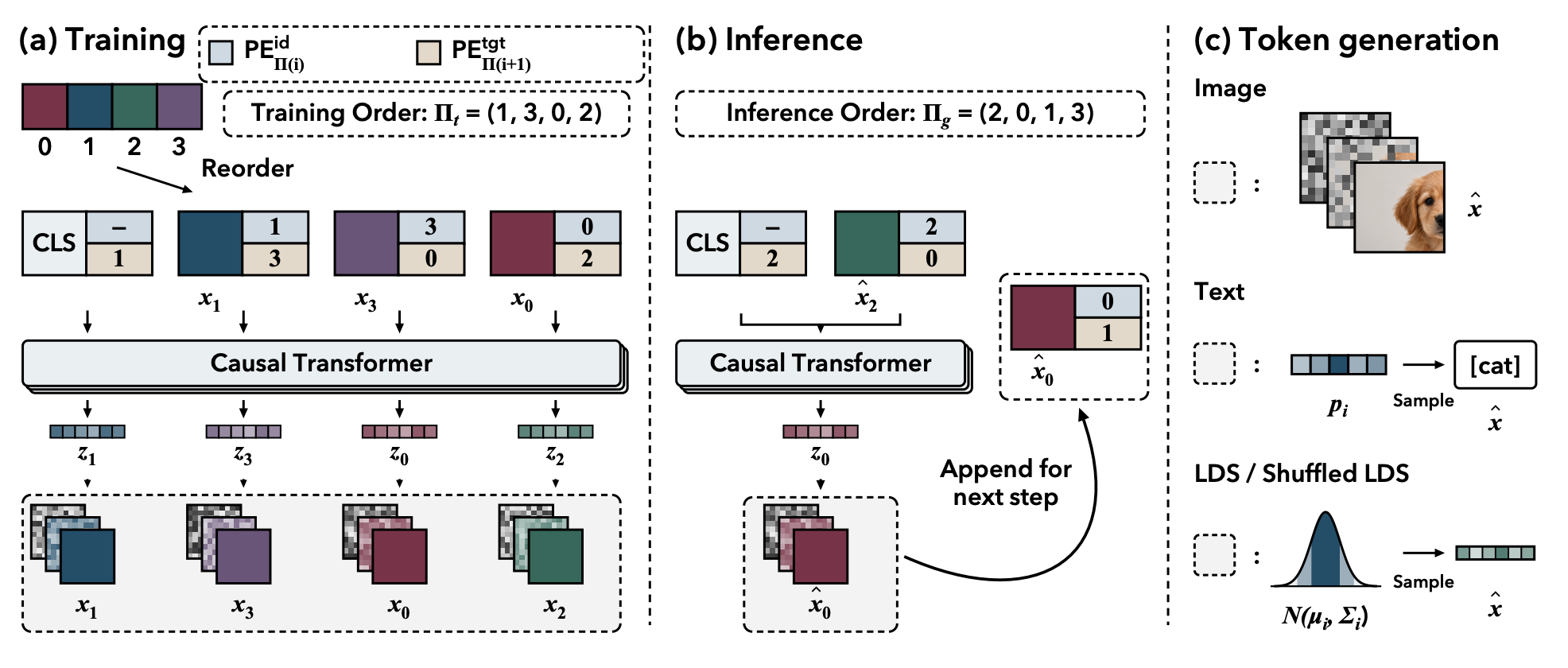
The best generation order depends on the data’s dependency structure: autoregressive order performs better on language and ordinary LDS, while random order performs better on images and shuffled LDS. A unified framework isolates order’s effects and explains its distinct roles during training and inference.
Raster or Random? Let the Data Decide
Lianghe Shi*, GuangChen Li*, Huijie Zhang, Yixuan Jia, Qing Qu (* equal contribution)
Under review
The best generation order depends on the data’s dependency structure: autoregressive order performs better on language and ordinary LDS, while random order performs better on images and shuffled LDS. A unified framework isolates order’s effects and explains its distinct roles during training and inference.
Generative Adaptation of Temporal Point Processes for Generalizable Event Sequence Prediction and Generation
Qingmei Wang*, GuangChen Li*, Yitian Wang, Tianyu Huang, Qianya Wang, Xiaobo Qin, Shulin Wang, YangHua, Hongteng Xu (* equal contribution)
Under review
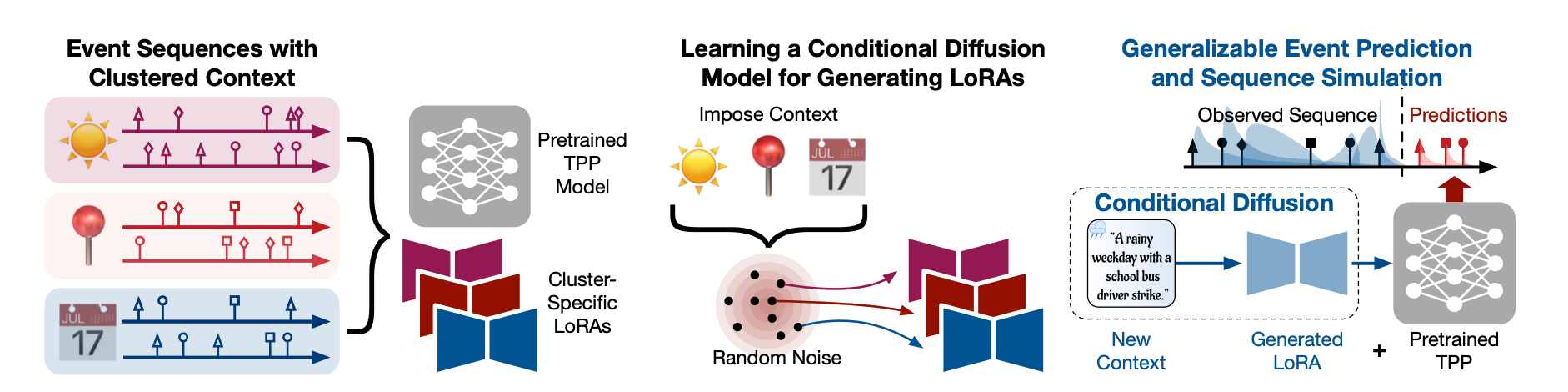
GA-TPP generates condition-specific LoRA adapters with conditional diffusion, enabling pretrained temporal point processes to adapt to unseen sequence contexts and distribution shifts.
Generative Adaptation of Temporal Point Processes for Generalizable Event Sequence Prediction and Generation
Qingmei Wang*, GuangChen Li*, Yitian Wang, Tianyu Huang, Qianya Wang, Xiaobo Qin, Shulin Wang, YangHua, Hongteng Xu (* equal contribution)
Under review
GA-TPP generates condition-specific LoRA adapters with conditional diffusion, enabling pretrained temporal point processes to adapt to unseen sequence contexts and distribution shifts.