2027
Raster or Random? Let the Data Decide
Lianghe Shi*, GuangChen Li*, Huijie Zhang, Yixuan Jia, Qing Qu (* equal contribution)
Under review
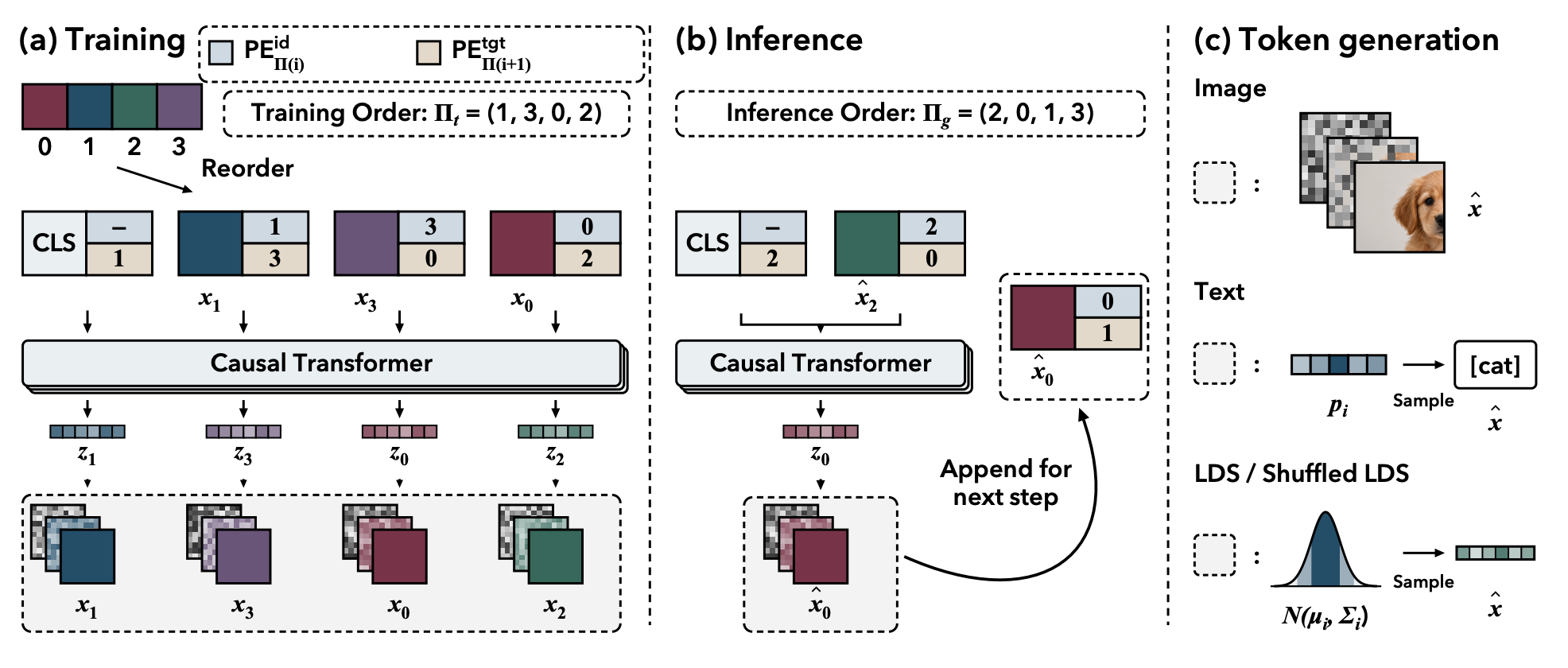
The best generation order depends on the data’s dependency structure: autoregressive order performs better on language and ordinary LDS, while random order performs better on images and shuffled LDS. A unified framework isolates order’s effects and explains its distinct roles during training and inference.
Raster or Random? Let the Data Decide
Lianghe Shi*, GuangChen Li*, Huijie Zhang, Yixuan Jia, Qing Qu (* equal contribution)
Under review
The best generation order depends on the data’s dependency structure: autoregressive order performs better on language and ordinary LDS, while random order performs better on images and shuffled LDS. A unified framework isolates order’s effects and explains its distinct roles during training and inference.
Generative Adaptation of Temporal Point Processes for Generalizable Event Sequence Prediction and Generation
Qingmei Wang*, GuangChen Li*, Yitian Wang, Tianyu Huang, Qianya Wang, Xiaobo Qin, Shulin Wang, YangHua, Hongteng Xu (* equal contribution)
Under review
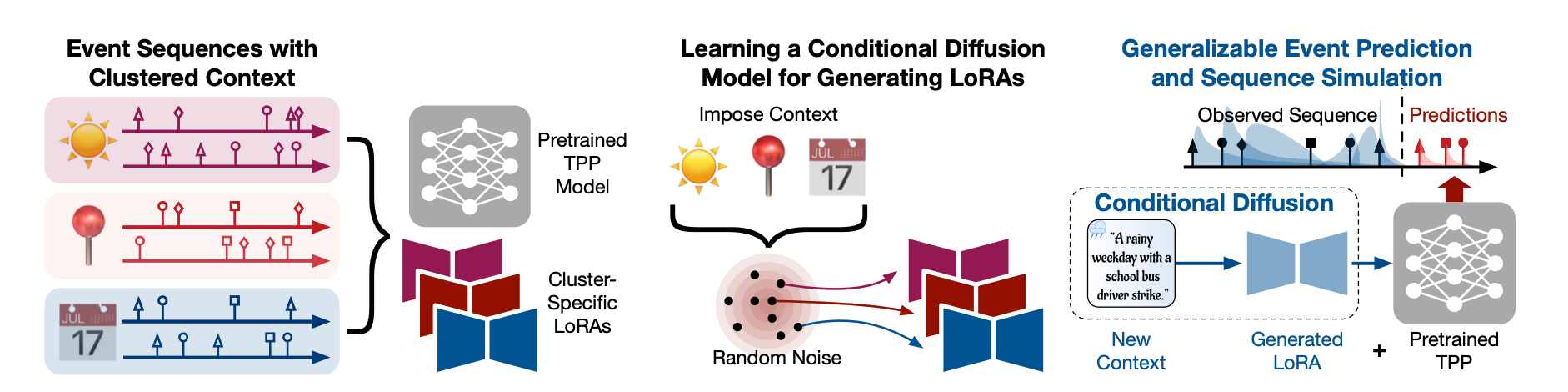
GA-TPP generates condition-specific LoRA adapters with conditional diffusion, enabling pretrained temporal point processes to adapt to unseen sequence contexts and distribution shifts.
Generative Adaptation of Temporal Point Processes for Generalizable Event Sequence Prediction and Generation
Qingmei Wang*, GuangChen Li*, Yitian Wang, Tianyu Huang, Qianya Wang, Xiaobo Qin, Shulin Wang, YangHua, Hongteng Xu (* equal contribution)
Under review
GA-TPP generates condition-specific LoRA adapters with conditional diffusion, enabling pretrained temporal point processes to adapt to unseen sequence contexts and distribution shifts.